
Engineering the safety layer for advanced AI.
We research and build the safeguards, control protocols and compliance systems that keep powerful AI systems secure, monitored and accountable.
Three ways advanced AI can fail, and the defenses that stop it.
Our work sits where AI safety research meets real deployments: the filters in front of models, the oversight around AI agents, and the legal duties of the companies that build them.
Safeguards & misuse prevention
Input filters that catch prompt injection, jailbreaks and requests for serious harm, without blocking legitimate users.
- Detection and over-refusal benchmarks
- Evasion and obfuscation testing
- LLM-as-classifier evaluation
AI control
Protocols for using capable AI systems safely even if they are trying to subvert oversight: monitoring, auditing and deferral.
- Trusted monitoring and audit budgets
- Red-team / blue-team control games
- Safety–usefulness tradeoffs
AI governance & compliance
Turning new frontier-AI laws into concrete engineering controls, and showing where those laws leave gaps.
- California SB 53 and New York RAISE Act
- EU AI Act general-purpose AI rules
- Incident reporting and risk frameworks
Our projects
Each project is a working, tested codebase with reproducible results and a plain statement of its limitations.
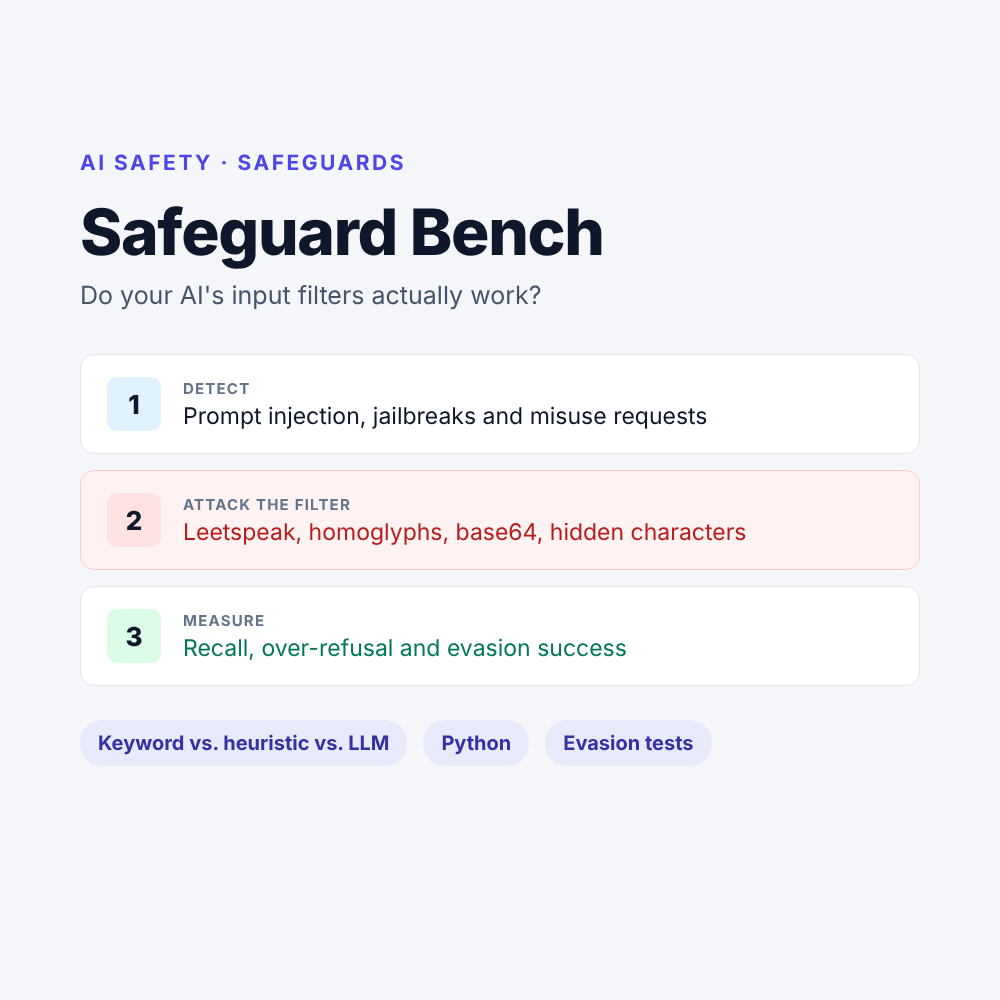
Safeguard Bench
A benchmark for LLM input safeguards. It measures how well a filter detects prompt injection, jailbreak framing and misuse requests; how often it wrongly blocks harmless questions that only sound risky; and whether attacks slip through after obfuscation such as leetspeak, look-alike characters, hidden characters and base64 encoding.
A keyword blocklist missed 82% of attacks and blocked 40% of tricky-but-harmless questions. Normalizing text before classifying defeated most cheap obfuscation tricks. Spaced-out letters remain an open weakness.
| Metric | Keyword blocklist | Normalized heuristic |
|---|---|---|
| Over-refusal on tricky prompts | 40% | 0% |
| Evasion via hidden characters, homoglyphs, base64 | 100% | 0% |
| Evasion via spaced-out letters | 100% | 54% |
Control Lab
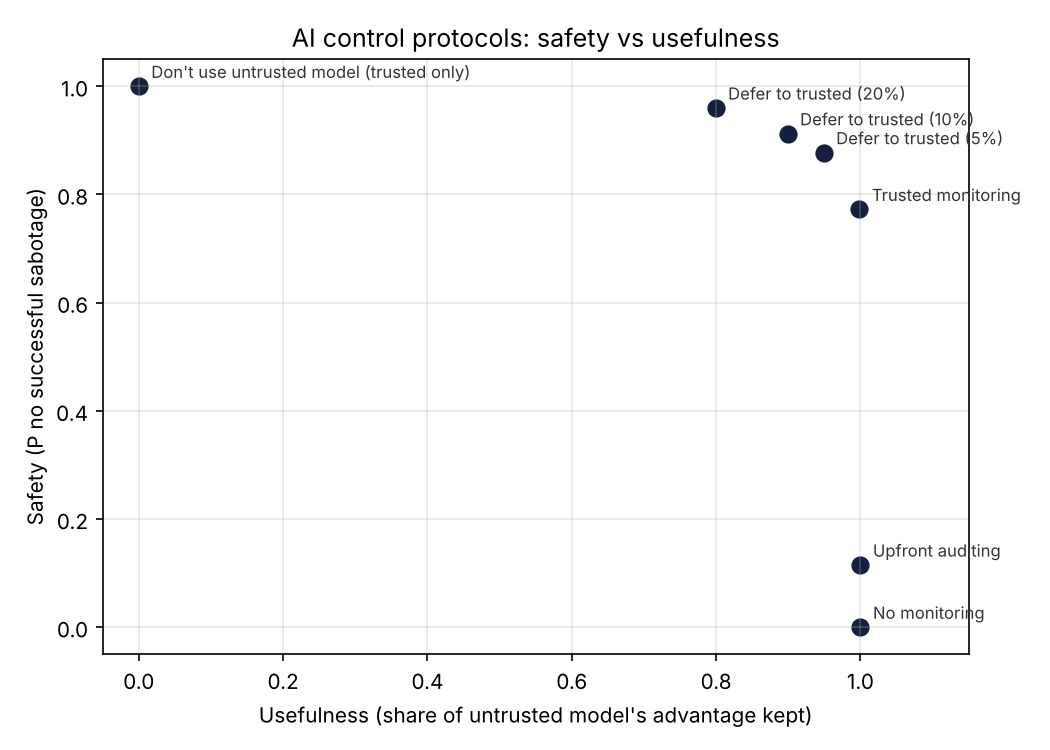
A reproducible simulation of the AI control game from the research literature. An untrusted model that may secretly attempt sabotage works through 1,000 tasks; the blue team has a weaker trusted model, a suspicion monitor and a 2% human audit budget; the red team picks its best attack rate. We measure safety against that worst case, and how much of the untrusted model's usefulness each protocol keeps.
Pointing a 2% audit budget where a monitor flags suspicion raised safety from 12% to 77%. Deferring the next 10–20% most suspicious tasks to the trusted model reached 91–96% safety while keeping 80–90% of usefulness.
| Protocol | Safety | Usefulness |
|---|---|---|
| Upfront auditing | 12% | 100% |
| Trusted monitoring | 77% | 100% |
| Defer to trusted (10%) | 91% | 90% |
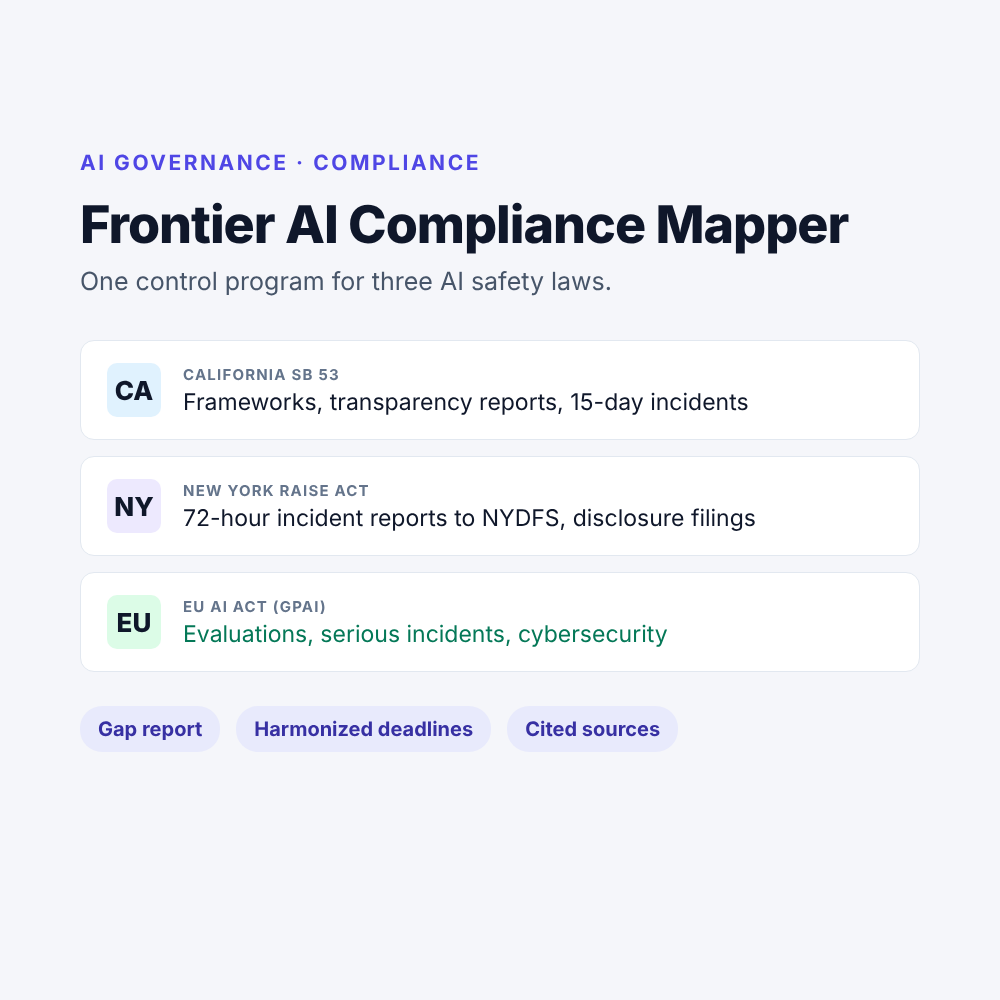
Frontier AI Compliance Mapper
A tool that maps a frontier AI developer's obligations under California's SB 53, New York's RAISE Act and the EU AI Act's general-purpose AI rules. It works out which laws apply, groups every obligation under one shared internal control, flags gaps, and sets a single operating standard that satisfies every regime at once. Every obligation cites its source.
Neither US law requires independent audits, and incident duties only start once a developer discovers a problem: nothing requires the monitoring that would catch a model behaving well only while it is being tested.
| Regime | Incident reporting | In force |
|---|---|---|
| California SB 53 | 15 days (24 h if imminent harm) | Jan 2026 |
| New York RAISE Act | 72 hours (24 h if imminent harm) | Jan 2027 |
| EU AI Act (systemic-risk models) | Without undue delay | Aug 2025 |
What we're working on next
Each project's limitations define its next step.
LLM monitors on real agent transcripts Now
Replacing simulated suspicion scores in Control Lab with an LLM monitor that reads real AI agent actions, to measure how well trusted monitoring works in practice.
Held-out safeguard evaluation Now
An independently written test set and a head-to-head comparison against LLM-based classifiers, so reported accuracy reflects real-world performance.
Smarter red teams Next
Letting the attacker choose how subtle each sabotage attempt is, and adding trusted-editing and resampling protocols for the blue team.
Tracking new AI rules Next
Extending the compliance mapper as regulators issue guidance, including New York's new oversight office at the Department of Financial Services.
Principles
Adversarial by default
We assume attackers, and possibly the AI itself, will look for the gap, and we test for it.
Measure, don't assume
Every claim is backed by a reproducible experiment, benchmark or cited source.
Honest about limits
We publish what our results do not show, alongside what they do.
Adam Goldfine
Adam is a full stack software engineer with more than a decade of experience building production systems, including AI applications that handle sensitive health data under HIPAA. He has served as acting CTO and engineering director, leading teams of up to 16 developers, and brings an information-security background to AI safety: securing the systems around models, not just the models themselves.
Services
Safeguard evaluation & red-teaming
We test your AI application's filters and agents against prompt injection, jailbreaks and obfuscation, and report what gets through and how to fix it.
AI agent control & monitoring
We design monitoring, audit and permission controls for AI agents that act on your systems and data, sized to your risk and budget.
Frontier AI compliance
We map your obligations under SB 53, the RAISE Act and the EU AI Act to concrete controls, and close the gaps.
Building or deploying advanced AI?
Let's talk about how to make it secure, controllable and compliant. Free initial consultation.
Startup Systems Alignment Labs is a division of Startup Systems. Research results are from the projects described above and their stated assumptions; simulated results are labeled as such. Compliance summaries are for engineering and planning purposes and are not legal advice.